
So...how did we ACTUALLY move to Spain?
The biggest question I was asked when I started telling people we were moving to Spain was simple: how? Visas, NIE numbers, bank accounts, health insurance — here's the honest breakdown of what it actually took.
The biggest question I was asked when I started telling people we were moving to Spain was simple:
How?
Which, to be fair, would probably be the first thing I would ask, too.
And no, I did not get a job in Spain. I found a job that would let me come to Spain. Or, really, go anywhere that allows digital nomads, which is a weird and wonderful little corner of immigration law that I now know far too much about.
So let's start with the basics.
A digital nomad is someone who works remotely and can do that work from another country. A lot of digital nomads are the "travel from place to place with a laptop and a backpack" kind of people. And honestly? Good for them. That sounds exciting and also like my personal nightmare with two kids, three cats, a dog, and a husband who has to help manage the chaos.
Then there's another group of us.
The people who are not trying to bounce from country to country. We are trying to find one new place to land. One new place to build a life. One new place where we can work, raise our kids, buy groceries, figure out the school system, and maybe not live under the "leadership" of the mango moron.
But here's the thing: you can't just get a "digital nomad job." That's not really how it works. Just like finding remote work anywhere, you have to find a job you are actually qualified for. You have to find a company willing to hire you. And if you are trying to apply for a visa, you also have to make sure that company is willing to provide the paperwork required by the country you are trying to move to.
Which is where things get fun.
And by fun, I mean wildly stressful.
I've been working remotely since 2020. I started as an Executive Assistant to a fractional CFO in a W2 position. When we first started seriously looking at Spain, I thought I had it all figured out. I had a salaried W2 job. I met the income requirements. My boss at the time was supportive of me immigrating. I had been promised the paperwork I needed.
And then, two weeks after that promise, I was laid off because I hurt someone's ego.
But that is a story for another day.
That happened on the last day of July 2025, and for about 24 hours, I panicked. Like full-body, what-the-hell-are-we-going-to-do-now panic. We had already started the Spain ball rolling, and I knew if I wanted to keep my promise to my family and get us there the following June, I had to move fast.
So I registered an LLC in my name and started researching everything I could about Spain's Digital Nomad Visa.
What was the difference between applying as a W2 employee versus a 1099 contractor? Could I use my VA benefits to offset my income? What paperwork would I need? What would my employer need to provide? And how in the actual fuck was I going to make sure I could meet the minimum income requirement for a family of four?
The good news is that I am good at what I do, and I network like a mofo.
Within a week, I had a meeting with someone I had met at a networking event. By the end of August, I had full-time hours in a 1099 role. And honestly? That panic-induced pivot ended up being one of the best things that could have happened for our visa process.
Because Spain changed some of what they would accept from W2 employees applying for the Digital Nomad Visa, and the 1099 route ended up being a lot cleaner for us.
Not easy.
Cleaner.
There is a difference.
Now, you might be thinking: if you registered your own LLC, why didn't you just apply under your own business?
That's a great question, and I would love to tell you the answer.
Shout out to Elyse Myers. IYKYK.
For Spain's Digital Nomad Visa, if you are going the 1099 route, the company you are contracting with needs to have been established for at least one year before you apply. That is on top of showing three months of pay that meets the minimum income requirement, getting a certificate of good standing from the state where the company is registered, and gathering all the other paperwork that makes you question every life choice you have ever made.
There can also be a hiccup if you are the business owner and then you pay yourself. The all-knowing and all-approving "they" generally like to see some level of separation. In other words, it helps if the company paying you is not just…you in a trench coat pretending to be a separate company.
So while registering my LLC was still useful for my work and future plans, it was not the magic visa shortcut I briefly hoped it might be.
Rude, honestly.
But let's bring this back to the real question: how do you become a digital nomad?
The first step is making sure you have work that can actually qualify you to be one.
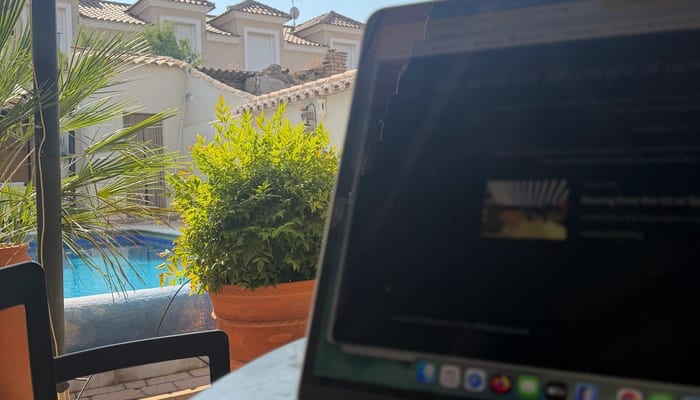
That sounds obvious, but it is the part people skip over when they see pretty videos of people working from sunny cafés in Europe. The laptop-on-a-balcony thing only works if you have income that meets the visa requirements and a company or client structure that fits what the country is asking for.
For us, that meant I needed remote work in my field. It meant the company had to be supportive of me working overseas. It meant they had to be willing to write a letter saying, essentially, "We know she is going to Spain and we do not care where she works from." It meant the company needed to have been in business long enough and be in good standing. It meant I needed to show enough income for myself, my husband, and our two kids.
And because nothing says "fun family adventure" like a spreadsheet, it also meant I had to understand exactly what money counted, what paperwork proved it, and what documents had to be dated within the right window.
This is where I need to be very clear: I am only talking about our experience applying for Spain's Digital Nomad Visa. Every country has its own requirements. They change. They are interpreted differently. Sometimes what one immigration attorney says does not perfectly match what another one says. Sometimes the internet is helpful. Sometimes the internet is a chaotic gremlin holding a stack of outdated PDFs.
So please, for the love of apostilles, do more than ask ChatGPT.
I say that with love.
And personal experience.
Because that is how you end up ordering the same paperwork twice because you did not realize it needed to be issued within six months of the application.
Yup. We did that.
For us, the work side of the visa came down to a few major things. I needed to work for a company that was genuinely supportive and willing to provide a letter saying I could work from overseas. The company needed to have been in business for more than a year and be in good standing. I needed to show at least three months of income at the minimum required amount for me plus three dependents, which at the time was €4,630 per month. And, preferably, that income needed to come from a single source because every extra income source means extra paperwork, and extra paperwork is where joy goes to die.
I also needed a boss and team who were cool as hell and supportive enough to help me get this done.
That part mattered more than I can explain.
Because yes, the visa is about income and paperwork and official documents, but it is also about people. People willing to write letters. People willing to answer questions. People willing to understand that your "quick admin request" is actually the thing standing between your family and the life you are trying to build.
So my advice, if you are at the beginning of this, is to start with the work.
Do you already work remotely? Great. Find out whether your current role could meet the requirements for the country you are looking at. Are you W2? Ask whether shifting to 1099 is even an option, but do not forget that contractors have to set aside money for taxes. Are you self-employed? Find out whether your business structure qualifies, how long it needs to have been operating, and what proof the country wants to see. Are you not remote yet? Start there. Look for remote jobs in your actual field, not some mythical "digital nomad job" that probably pays $11 and wants you to be available in six time zones.
And then talk to people.
Talk to immigration firms in the country you are considering. Talk to people who have done it. Read blogs. Join groups. Google things, yes, but do not blindly trust the AI summary at the top of the page or one random forum post from 2021. Requirements change, timelines matter, and paperwork details can be the difference between "approved" and "please start over."
Which, respectfully, no thank you.
We are still very much figuring this out as we go, but that is the point of this blog. We wanted to show the real version of how a regular family made this happen. Not the fantasy version where someone magically has passive income, no pets, no kids, and unlimited savings.
The real version.
The version where you panic for a day, register an LLC, network like your future depends on it, ask a million questions, redo paperwork, chase documents, and somehow keep going.
So if you are wondering how we moved to Spain, the first answer is: remote work.
The second answer is: paperwork.
The third answer is: stubbornness.
And honestly? A little bit of chaos.
Hope y'all are enjoying the ride. Send me your questions, because there is a very good chance I either already had the same one or learned the answer the annoying way.
Xoxo, homeacasa